Showing posts with label Apple. Show all posts

Wednesday, May 20, 2020

iPhone SE : A Challenge to Android

Apple continues to refresh its product lineups in 2020, which it started last year along with introduction to new apple services as a response to falling iPhone sales. Lesser number of iPhone are selling globally since smartphone industry is facing a slowdown worldwide with major markets like US reaching saturation point. With a reliance of more than 60% of total revenue on iPhone sales simply means Apple had to renew its old products and give people another reason to go and buy those to keep up-to expected quarterly figures.

One such product is iPhone SE, a refresh to original version launched in 2016. Apple made this phone possible by replacing brains of iPhone 8 by Apple's most powerful chip till that date (A13 Bionic). One other cosmetic change to make it distinguishable from iPhone 8 is to move that Apple logo (on the back) down to center.

source : wired


There are both demand and supply side justification for this new iPhone launch. Looking at demand side, people who can't get along new drastic changes with ever-evolving design, holding back to old iPhone and are in need of familiar hardware and software experience to upgrade, now have an excellent option in form of this is new iPhone. It can also be a good buy for first iPhone experience and such people are generally who are on android side of world, held by hefty price tag on new iPhone. iPhone SE is indeed a special edition phone because profit from each piece of iPhone sold is gonna be comparable to more expensive iPhone. This is possible in case of iPhone SE since Apple don't need to spend on R&D, a major cost factor for any other iPhone. Apple is seeking benefits of proprietary processor and already available design and production assembly of iPhone 8.   

Despite being a silent launch amid pandemic crisis, this phone started creating a lot of buzz among smartphone enthusiasts and reviewers and that's all because of it being cheapest iPhone model with starting price of  $399 in US. This new phone was very well received by online publications in US, in spite of  packing an age old hardware and design, citing all improvements Apple's A13 Bionic chip brings like improved raw computing power, next-gen HDR processing for photos and power efficient processor for better battery life. All this but more importantly highlighting that a brand like Apple which is generally associated with premium product and pricing, now has compelling option in smartphone under $400. Viewers around the globe having built same opinion on this new iPhone after going through these reviews. This can create a serious problem, since not every region is like US when it comes to smartphone market.

Consider case of world's second largest smartphone market - India. Compared to US, a buyer in India will have to spend 40% more to grab a starting model of this new phone i.e. 42.5 K Indian Rupees. When keeping in mind that average selling price of phones in India is still less than $160, a phone which is targeted as semi-premium mid-range option in US becomes a premium option in India. This high price also becomes unnoticeable when price war is prevalent in budget and semi-premium smartphone segment and there are several tempting options in android world like OnePlus 8. 

If someone had bought entry level variant of iPhone 8 in India, back at its launch in 2017, it had set him back 64 K Indian Rupees. This was back when only original iPhone SE and iPhone 6S were being assembled in India. In Mar 2019, Indian Govt. had approved Wistron's Rs 5000 Cr investment proposal to setup a mega-factory. This was big boost for Make India as newer iPhone models like iPhone 8 were getting ready to be manufactured in India. Indian made variant of original iPhone SE and iPhone 6S were  around 40% cheaper compared to importing from other country. Going by same figures and local manufacturing of new iPhone SE since it is essentially a revised iPhone 8,  iPhone SE could have started at a price around 38 K Indian rupees.

A 50% hike in GST on smartphones (from 12% to 18%) accompanied with weak Indian Rupee especially during pandemic crisis are a few reasons behind a price tag which otherwise could have been much more tempting for smartphone enthusiasts. Apart from these reasons, there are other possible explanations which focus on market demographics, product placement and pricing strategy. 

Two Chinese players dominate Indian smartphone market with a combined market share of 68% (as of Q4 2019) - Xiaomi, BBK Electronics. There is an ongoing fierce battle among various brands of these two players to undercut opponent's product offering by releasing same or better spec'd product at lower price. Their short term objective to sell as many phones as possible by keeping low profit margin, is to built a loyal user base for their long term aim to be leading Internet company. 

Apple has same long term objective but it's approach is different. Apple is never going to compete in this price war because it can't afford to lose it's reputation of being a premium company by selling cheap hardware. Apple is patiently waiting for time when purchasing power of young population in India is going to be like that of China, where most people who can afford to buy an iPhone can also spend on services . Till then, Apple will always want people in it's next biggest market (India) to perceive that owning an Apple product is symbol of power, luxury and excellence. Currently, even if Apple prices their phones somewhat lower (than what are they today) in India right now , they will not only miss out on profit margins but also won't get people who can afford to spend on subscription based services on it's platform. 

Due to a 5 year long software support and many Indians preferring Apple's age old hardware over latest tech in similarly priced Android phones, Apple is able to sell their very old models in India for many years. This gives it a good opportunity in highly price sensitive Indian market to earn surplus from first degree price discrimination .i.e. keep reducing selling price over years to make product come under purchasing power of more people.  

Talking about challenge in post's title, the challenge is not to compete by putting up a android phone with this year specs and design but to do same as what Apple did with its iPhone 8.  Android OEMs stand no chance to accept this challenge because they know they won't be able to sell one-tenth of sales of this iPhone since they will be competing in vast pool of latest spec'd Android phones.  


Wednesday, May 30, 2018

ONEPLUS : PRICING IS THE KEY ???


What does the trend in prices of Flagship Smartphones reveal ?

The graph below clearly depicts rising flagship smartphone prices. 

** base variant price

With Apple's latest iPhone X price touching the ceiling of $1000 price-point, an ultra-premium category of smartphone has emerged and industry in general is expected to experience a further rise in flagship smartphone prices. 

Apple did pave way for more expensive flagships but seriously an average non- geek person never need to spend that much. Budget smartphones are not only getting better but also cheaper over last 2-3 years. The surprising fact is that the rise in performance of these budget phones is such that they are almost equivalent to 2 year old flagships. They still lag behind to one of flagships phone major selling point i.e. camera quality. Budget phones in the range of $200 to $300 are most value for money option in the market.  

Similar Trends in Oneplus smartphone prices


*prices of all models are of base variant

Back in 2014, Oneplus originally started as real flagship killer with their Oneplus One. It became famous for providing flagship grade specs with just nearly half the price. It was able to capture everyone's attention to due to highly aggressive pricing.

As confirmed by above graph, there has been significant increase in launch price of base variant with every new model released from then onward. 

This clearly reveals company's change in strategy from selling super value for money smartphones to entering into semi-premium pricing segment.

Here is a comprehensive explanation which should explain a higher price tag by OnePlus.

1. Global Average Smartphone Price
Source:Gfk
One the most probable reason to start charging premium in prices might be with the case that the average selling price has been rising from last two years. According to market research firm Gfk, the average smartphone price saw a record high 10 percent rise in Q4 of 2017 making global average selling price to $363. Smartphone is single piece of tech that is used extensively by people of all ages. Keeping usage scenario and average use-cycle of around 2 years in mind, people might look to spend a good amount of their income on purchase of a smartphone. The increased purchasing power of consumers also must have played a role in increasing prices.

2.  Fierce Competition in Budget Segment

Budget segment of smartphone market is targeted by smartphone selling companies in any market, especially in highly price sensitive developing markets like that of India and China. In these countries, Chinese smartphone manufacturers are flooding the market with new smartphone launches every other week. There is a price war among these players to provide better specs than competition at even lower prices. This was not seen earlier as most of buyers knew not much about specs but thanks to media sources like YouTube and various tech websites, smartphone sellers are now targeting consumers with better specification as selling point.  
It might be the case that phone launched by a company in this price segment of around 15 to 20K is not a good sell just due to the fact that there are several other choices with consumer in this segment. This might have backed Oneplus to go with semi-premium strategy.

3.  Spending on Advertisement 


It is no surprise to anyone that it is the consumer who ultimately bear the burden of spending on advertisement in form of higher price tags. Oneplus originally started as company which only let their product did the the taking to it's audience. But soon after few years, it started it's advertisement campaign. It's major focus is on social media platforms like Twitter and YouTube. Oneplus strategy is to be as interactive with audience as possible and knowing their view-point and ideas. Oneplus also aims to reach a larger audience. Owing to risk averse nature of previous generation, people ready to spend more than Rupees 35K usually look at any well known brand like Samsung because they don't want to take chance with lesser known ones like Oneplus. Having a TV campaign rolled out with their brand ambassador Mr. Amitabh Bachchan, will help build trust in consumers with old mindset.

Recent Scenario (Launch of Oneplus 6)

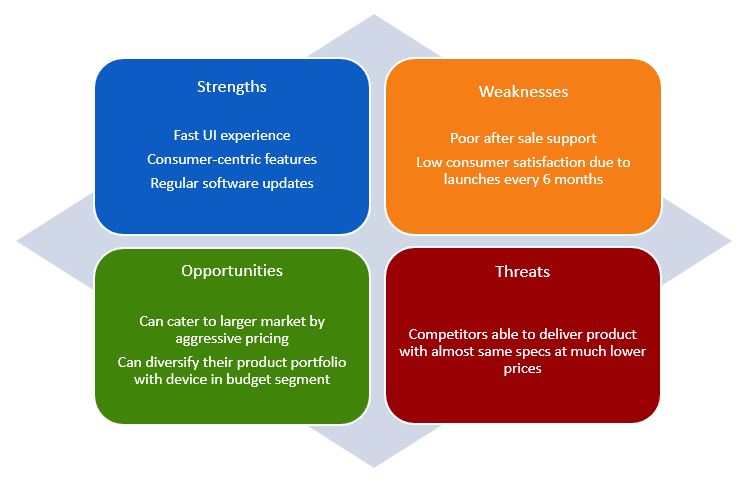
 As expected, Oneplus 6 was launched with even a higher price point than it's predecessor. The problem is that from it's last two-three launches, increase in number of features by Oneplus is not able to fully justify price hike. On top of that, new phone launches every six month keeps viable consumers guessing of next launch. Oneplus is already dealing with small consumer base in markets like India. It is very hard to think that with price hikes and frequent launches, Oneplus would be able to keep adding to list of people they serve, keeping in mind that any existing customer in these markets do not upgrade their  smartphones that often.

SWOT Analysis


Monday, July 3, 2017

ATTENTION!!! MISSING 3.5 mm HEADPHONE JACK. PLEASE REPORT IF FOUND....


MISSING HEADPHONE JACK...


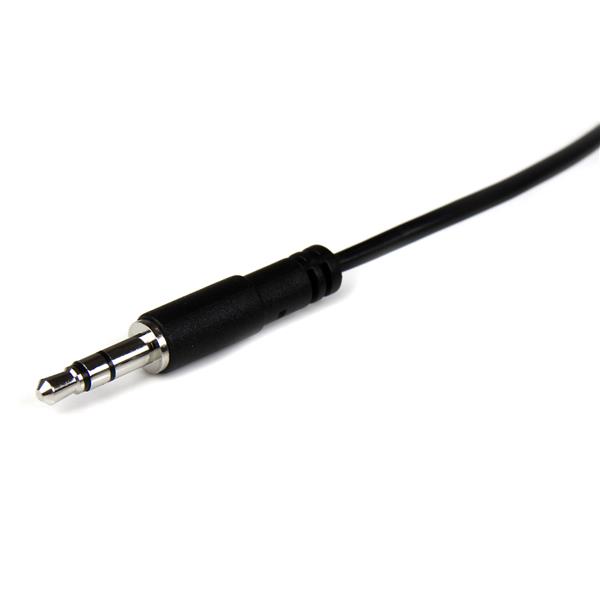
So, as you would have come to know till now, yeah it’s true, USB type C is going to be the new standard in android phones. 3.5 mm headphone jack was there for nearly 140 long years. Lightening port in iPhones and USB type C are going to replace your old trusty 3.5 mm headphone jack in coming years.

Guess. Who started it all? 


If you guessed it Apple just because it was absent on latest iPhone 7, you will surely be surprised to know that you got it wrong this time. No it wasn't Apple instead a Chinese smartphone making company Oppo.
Yes, Oppo's Finder launched way back in 2012 lacked a headphone jack followed by their another phone R5 in 2014 only to keep Oppo R5 freaking 4.85 mm thin.


After that it was only in 2016 that another Chinese company LeEco had courage to launch LeEco Le2 and Le Max 2. It was after then Apple's iPhone 7 included earpods with lightening connector and no place for headphone jack on iPhone.

Enough of history for now, so what does it all mean for upcoming devices and what is going to be company's approach towards this new trend in smartphone industry?

Well it seems like that whether it is these Chinese companies like Oppo, Xiaomi, Lenovo, Oneplus or tech giants like Apple, no one is really pushing it's customers really hard to completely switch to new technology. This can be understood by the fact that all such companies included an adapter to plug those old trusty headphones. It is due to a simple fact that their premium customers might switch to other high-end smartphone having a headphone jack for best experience of high quality expensive headphones.

FUN FACT:

Samsung, although being leader in android smartphones, decided to keep 3.5 mm headphone jack on all it's flagships phones till now, including the latest s8 and s8+.

The usual reason stated by companies like Leco is that sound output is going to be clearer on digital USB-C connection and users will enjoy better audio experience on their new CDLA technology. Interestingly, LeEco was able to clear their inventory on very first day of sale, gathering 1.22 billion RMB.

Apple also stated their 3 main reasons on dropping headphone jack during iPhone 7 launch event.

 First being the fact that now users can use their new earpods with lightening connector at the end and continue to use their headphones using an adapter, both included in box (Seriously Apple, does this even really qualify for being a reason??).

Second reason, headphone jack takes up lot of precious internal space, so ditching it, not only created space for dual lens camera system on 7 plus model but also for a new hepatic engine.

Third reason is that they believed that wireless is the future and thus they introduced airpods (wireless earpods) for just $160.(Only Apple can do this, just Apple things)


According to industry experts,  the real reason behind this move by Apple is to open a new revenue stream. Yes that's right, there is a lot going on than that you might have expected.
 Just because lightening connector is proprietary to Apple, any manufacturer who come up with 3rd party accessories with lightening connector, has to pay Apple for each item sold. As you might have guessed till now, these manufacturers pass on this royalty fees to customers in form of higher prices. 
In the end it is a customer who suffers and Apple makes money without getting involved in this transaction.


The real problem is not the fact that Apple is charging royalty fee for their patented port, but the fact that it is as high as $4-5 per item when compared to that of HDMI cable ($0.05).

So,what does it all comes down to?

 One simply does not get a real better audio experience from these new connectors. Losing the ability to charge your device while listening to music is frustrating for some users.

We hope that these shortcomings gets sorted out in coming years. Until then, I wish everyone 

A VERY HAPPY DONGLE LIFE !!!