Showing posts with label SWOT ANALYSIS. Show all posts

Sunday, August 12, 2018

JIO PHONE 2 & JIO PHONE'S SUCCESS : STRATEGY EXPLAINED

Jio's Strategy and Success of Jio Phone 

Not just like any other feature phone launch, which goes unnoticed, the launch of Jio phone created quite a buzz across the globe. This was partly due to fact that it had handful of smart features but mostly due to it's effectively free price tag.


Jio phone plans

Before the launch of Jio phone , there was market base of more than 400 Million 2G subscribers in India. And as you might have guessed they were mostly on old feature handsets. Considering such a huge consumer base who would be happily willing to switch to 4G network, these potential users were let down by two factors -No such 4G enabled feature phone availability and high prices for 4G services which were definitely not affordable for people still on feature phone. 

If Jio would have just lowered down prices of plans for feature phone users, this would have let to a creation of demand for 4G enabled feature phone, only to be absorbed by players like Micromax, Intex and Nokia. It would have created another problem for Jio i.e. Users might have switched to some other telecom service provider like Airtel and Vodafone.

The aim of Jio was to lock down it's potential new users into Jio ecosystem as it will help them start a new stream of revenue. Launching Jio phone not only made Jio realize this goal but also absorb the demand that would have got created, just as previously done by launching Reliance Lyf brand of affordable smartphones at the time of launch of Jio internet services. 

And for those who think INR 1500 deposited in form of what Jio calls as security deposit is refundable after 3 years, there is clear mention that it is gonna happen only if Jio phone users get recharge done each and every month for 3 years. It is highly unlikely that anyone would be living with this hardware for so long.


So with a clear objective of capturing feature phone market share, Jio till now has been quite successful in it. As of July 2018, Jio phone had a market share of around 47% in Indian feature phones market. In the first quarter of 2018, Jio phone had global market share of around 15%. What's even more impressive is the fact that this feat of becoming global leader in feature phone market was achieved by Jio phone in just 10 months.

Jio Phone 2

Second generation Jio phone or as they call it Jio phone 2 can be seen as an iterative version of Jio phone. It comes with a few improvements and more importantly these improvements address some of the biggest problems of first generation Jio phone. 

Jio phone came with a standard T9 keyboard layout, which made providing any input to phone very cumbersome. Jio phone 2 improves on it by having a standard QWERTY layout for keyboard. This makes typing experience much better especially in apps like Whatsapp and Facebook.


Watching YouTube on Jio phone was never a fun experience. Thanks to Jio phone 2, the screen aspect ration has changed and now the screen is much wider making video watching experience much immersive.
Jio is asking you to hold them $43.69 (3000 INR) for a brand new Jio phone 2. 

Though Jio phone 2 provides some functional improvements over it's last model. It will not make much of a difference when it comes to overall experience as they have not improved on the most important aspect of a feature phone like Jio Phone i.e. voice input.

What people don't understand is that adding INR 2000 more can get them a decent Android smartphone like Nokia's Android One phone. I am not saying that it's gonna be lag free experience but still far better than what Jio phone 2 has to offer, especially considering the fact that target audience for Jio phone are feature phone users. 

Wednesday, May 30, 2018

ONEPLUS : PRICING IS THE KEY ???


What does the trend in prices of Flagship Smartphones reveal ?

The graph below clearly depicts rising flagship smartphone prices. 

** base variant price

With Apple's latest iPhone X price touching the ceiling of $1000 price-point, an ultra-premium category of smartphone has emerged and industry in general is expected to experience a further rise in flagship smartphone prices. 

Apple did pave way for more expensive flagships but seriously an average non- geek person never need to spend that much. Budget smartphones are not only getting better but also cheaper over last 2-3 years. The surprising fact is that the rise in performance of these budget phones is such that they are almost equivalent to 2 year old flagships. They still lag behind to one of flagships phone major selling point i.e. camera quality. Budget phones in the range of $200 to $300 are most value for money option in the market.  

Similar Trends in Oneplus smartphone prices


*prices of all models are of base variant

Back in 2014, Oneplus originally started as real flagship killer with their Oneplus One. It became famous for providing flagship grade specs with just nearly half the price. It was able to capture everyone's attention to due to highly aggressive pricing.

As confirmed by above graph, there has been significant increase in launch price of base variant with every new model released from then onward. 

This clearly reveals company's change in strategy from selling super value for money smartphones to entering into semi-premium pricing segment.

Here is a comprehensive explanation which should explain a higher price tag by OnePlus.

1. Global Average Smartphone Price
Source:Gfk
One the most probable reason to start charging premium in prices might be with the case that the average selling price has been rising from last two years. According to market research firm Gfk, the average smartphone price saw a record high 10 percent rise in Q4 of 2017 making global average selling price to $363. Smartphone is single piece of tech that is used extensively by people of all ages. Keeping usage scenario and average use-cycle of around 2 years in mind, people might look to spend a good amount of their income on purchase of a smartphone. The increased purchasing power of consumers also must have played a role in increasing prices.

2.  Fierce Competition in Budget Segment

Budget segment of smartphone market is targeted by smartphone selling companies in any market, especially in highly price sensitive developing markets like that of India and China. In these countries, Chinese smartphone manufacturers are flooding the market with new smartphone launches every other week. There is a price war among these players to provide better specs than competition at even lower prices. This was not seen earlier as most of buyers knew not much about specs but thanks to media sources like YouTube and various tech websites, smartphone sellers are now targeting consumers with better specification as selling point.  
It might be the case that phone launched by a company in this price segment of around 15 to 20K is not a good sell just due to the fact that there are several other choices with consumer in this segment. This might have backed Oneplus to go with semi-premium strategy.

3.  Spending on Advertisement 


It is no surprise to anyone that it is the consumer who ultimately bear the burden of spending on advertisement in form of higher price tags. Oneplus originally started as company which only let their product did the the taking to it's audience. But soon after few years, it started it's advertisement campaign. It's major focus is on social media platforms like Twitter and YouTube. Oneplus strategy is to be as interactive with audience as possible and knowing their view-point and ideas. Oneplus also aims to reach a larger audience. Owing to risk averse nature of previous generation, people ready to spend more than Rupees 35K usually look at any well known brand like Samsung because they don't want to take chance with lesser known ones like Oneplus. Having a TV campaign rolled out with their brand ambassador Mr. Amitabh Bachchan, will help build trust in consumers with old mindset.

Recent Scenario (Launch of Oneplus 6)

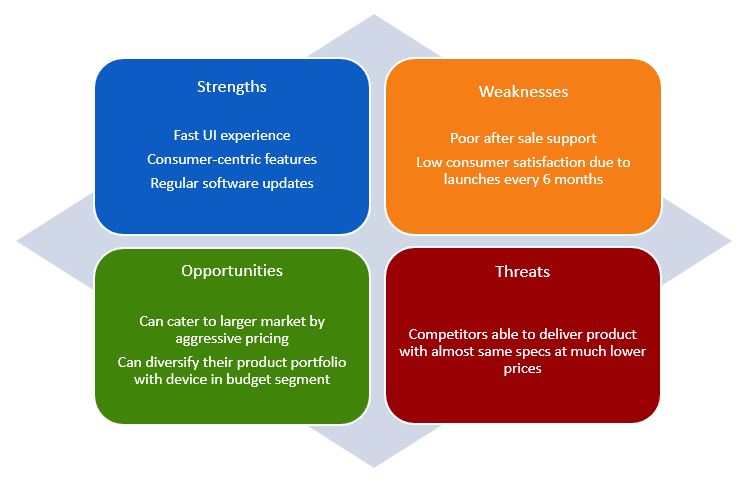
 As expected, Oneplus 6 was launched with even a higher price point than it's predecessor. The problem is that from it's last two-three launches, increase in number of features by Oneplus is not able to fully justify price hike. On top of that, new phone launches every six month keeps viable consumers guessing of next launch. Oneplus is already dealing with small consumer base in markets like India. It is very hard to think that with price hikes and frequent launches, Oneplus would be able to keep adding to list of people they serve, keeping in mind that any existing customer in these markets do not upgrade their  smartphones that often.

SWOT Analysis