Showing posts with label smartphone industry. Show all posts

Saturday, December 22, 2018

BLACKBERRY KEY 2: WHERE IS THE KEY???

If you are unaware about Blackberry's comeback, here is a quick info-

After vanishing into thin air due to stiff competition from Android and iOS, Blackberry came to life when it entered into long-term brand licensing agreement with TCL Corporation and Optiemus Infracom. According to this hardware licensing partnership, Optiemus Infracom holds the right to produce Blackberry-branded smartphones in India, Bangladesh, Indonesia, Nepal and Sri Lanka while TCL everywhere outside these nations.

Blackberry KeyOne release in early 2017 followed by Key2 in mid 2018 laid the foundation for comeback of Blackberry mobiles.

Source:- https://blackberrymobile.com/storage/2018/03/03-1.jpg

I grew up in years during which phones got from being big and practically non-portable to small, everyday and everywhere devices. This post is written by a guy who never got a chance to own and use a blackberry mobile phone until December of 2014. This was mainly due to two very practical reasons - first me being underage for phone usage during blackberry phone's glory days (yes this was a thing back then, now we have toddlers handling smartphones like a pro) and second one is somewhat even valid till nowadays i.e. their affordability.

Talking about pricing and affordability, BB KeyOne came with launch-price tag of $549 and Key2 with an increment of $100 to the previous one. Well at-first pricing seems to be kind of okay, considering the fact that both of these are blackberry's flagship devices, and even more when we have Samsung and Apple breaking $1000 price ceiling with their latest flagship pricing. Until you look at specs-sheet, which looks like that of a mid-grade phone rather than a flagship device and totally unacceptable for launch price tag of phone. We have devices with same internal hardware specifications, costing less than half the price.

Well at this point, one might argue that Blackberry has always been a software company with security at it's core values and has been providing those services with in-built features in their phones. So aren't they charging premium price for those services which make Key2 the most secure Android device available for masses to purchase. Yes, this can certainly be one of the explanations.

Blackberry's target consumers consist of people who really need high level of security provided by their devices and a small group of rich nostalgic tech-savvy people. This is the case because all other people not listed above are far better-off buying some other phone in same price segment like that of Oneplus.

Considering the fact that people who sincerely require that high end level of security are the one that can carry only one device and are rich enough to spend on security (top-officials). These people are generally willing to have excellent end user-experience, which is lacking in both KeyOne and Key2.

Blackberry can take advantage of it's unique position of being one of the very few companies to cater to such an audience, especially in Android domain. They can provide better overall experience by having the best in class hardware available in their upcoming devices and launch them with even a higher price-tag than it's predecessors.         

Increasing the launch price, can deter other people to make a purchase. This situation can be handled by having a more affordable option, which Blackberry tried to do by having another model named Key2 LE. With lower price-tag of $400, Blackberry Key2 LE still can't be called an affordable and certainly not a value-for-money option in emerging markets like India, where there are phones with excellent price to performance ratio in $200-$300 price range.

When Blackberry was in it's glory days, people did not buy blackberry just because of baked-in high level security features but due to simple fact that a blackberry phone was host of very well implemented smart features found during those days (especially that tactile physical keyboard and BBM). Unless Blackberry comes out with a compelling option, people will find it hard to buy and recommend a blackberry. While Blackberry's USP (unique selling point) i.e. in-built security features might not be as desirable among audience as compared to other brands. Blackberry can still make a comeback with offerings that are justifiable for their launch price. 


Wednesday, May 30, 2018

ONEPLUS : PRICING IS THE KEY ???


What does the trend in prices of Flagship Smartphones reveal ?

The graph below clearly depicts rising flagship smartphone prices. 

** base variant price

With Apple's latest iPhone X price touching the ceiling of $1000 price-point, an ultra-premium category of smartphone has emerged and industry in general is expected to experience a further rise in flagship smartphone prices. 

Apple did pave way for more expensive flagships but seriously an average non- geek person never need to spend that much. Budget smartphones are not only getting better but also cheaper over last 2-3 years. The surprising fact is that the rise in performance of these budget phones is such that they are almost equivalent to 2 year old flagships. They still lag behind to one of flagships phone major selling point i.e. camera quality. Budget phones in the range of $200 to $300 are most value for money option in the market.  

Similar Trends in Oneplus smartphone prices


*prices of all models are of base variant

Back in 2014, Oneplus originally started as real flagship killer with their Oneplus One. It became famous for providing flagship grade specs with just nearly half the price. It was able to capture everyone's attention to due to highly aggressive pricing.

As confirmed by above graph, there has been significant increase in launch price of base variant with every new model released from then onward. 

This clearly reveals company's change in strategy from selling super value for money smartphones to entering into semi-premium pricing segment.

Here is a comprehensive explanation which should explain a higher price tag by OnePlus.

1. Global Average Smartphone Price
Source:Gfk
One the most probable reason to start charging premium in prices might be with the case that the average selling price has been rising from last two years. According to market research firm Gfk, the average smartphone price saw a record high 10 percent rise in Q4 of 2017 making global average selling price to $363. Smartphone is single piece of tech that is used extensively by people of all ages. Keeping usage scenario and average use-cycle of around 2 years in mind, people might look to spend a good amount of their income on purchase of a smartphone. The increased purchasing power of consumers also must have played a role in increasing prices.

2.  Fierce Competition in Budget Segment

Budget segment of smartphone market is targeted by smartphone selling companies in any market, especially in highly price sensitive developing markets like that of India and China. In these countries, Chinese smartphone manufacturers are flooding the market with new smartphone launches every other week. There is a price war among these players to provide better specs than competition at even lower prices. This was not seen earlier as most of buyers knew not much about specs but thanks to media sources like YouTube and various tech websites, smartphone sellers are now targeting consumers with better specification as selling point.  
It might be the case that phone launched by a company in this price segment of around 15 to 20K is not a good sell just due to the fact that there are several other choices with consumer in this segment. This might have backed Oneplus to go with semi-premium strategy.

3.  Spending on Advertisement 


It is no surprise to anyone that it is the consumer who ultimately bear the burden of spending on advertisement in form of higher price tags. Oneplus originally started as company which only let their product did the the taking to it's audience. But soon after few years, it started it's advertisement campaign. It's major focus is on social media platforms like Twitter and YouTube. Oneplus strategy is to be as interactive with audience as possible and knowing their view-point and ideas. Oneplus also aims to reach a larger audience. Owing to risk averse nature of previous generation, people ready to spend more than Rupees 35K usually look at any well known brand like Samsung because they don't want to take chance with lesser known ones like Oneplus. Having a TV campaign rolled out with their brand ambassador Mr. Amitabh Bachchan, will help build trust in consumers with old mindset.

Recent Scenario (Launch of Oneplus 6)

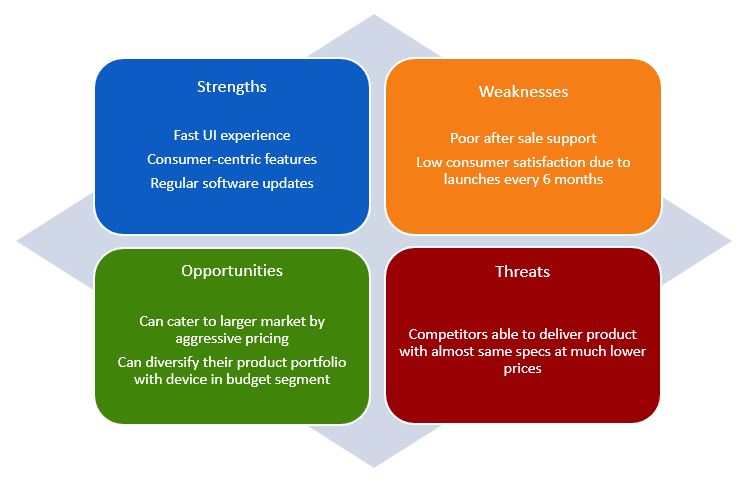
 As expected, Oneplus 6 was launched with even a higher price point than it's predecessor. The problem is that from it's last two-three launches, increase in number of features by Oneplus is not able to fully justify price hike. On top of that, new phone launches every six month keeps viable consumers guessing of next launch. Oneplus is already dealing with small consumer base in markets like India. It is very hard to think that with price hikes and frequent launches, Oneplus would be able to keep adding to list of people they serve, keeping in mind that any existing customer in these markets do not upgrade their  smartphones that often.

SWOT Analysis


Sunday, January 22, 2017

SMARTPHONE INDUSTRY IN INDIA (2017)


AN INSIGHT INTO THE SMARTPHONE INDUSTRY IN INDIA


Analyzing the Present Smartphone Market Situation


Smartphone market in India is highly price sensitive due to a large diversity of income level people present in the country and more people entering the upper middle and middle class from low level. It is very important for any company to get it's pricing correct in a market where the average price of a mobile is just $100. 


Year 2016 was a fantastic year for smartphone industry in India witnessing highly aggressive pricing policy by companies and consumers enjoying best for every rupee they spent. 
In first quarter of 2016 Indian market surpassed America's smartphone market to become world's second largest smartphone market.
The smartphone shipment in 3rd quarter reached 32.3 million units, crossing 30 million mark for the first time. 

A interesting point here is growing dominance of 
Chinese OEMs since they are able to provide features comparatively at very low price level. A decent part of others in pie graph above is Xiaomi's share. Although Samsung remains at the top as always but it saw a decline in the market share due to these Chinese companies like Xiaomi, Oppo, Vivo. 
The boom in the demand in Q3 can be accounted to the festive season and various big discounts offered by amazon, flipkart and snapdeal.

What's the Big Deal?

Why are so many Smartphone Manufacturing Firms are eyeing India as their next Big Market?


Smartphone industry in India is booming these days and much of it is credited to increase in purchasing power of common man as well as highly aggressive pricing policy of products by many smartphone manufacturers.


India has the fastest-growing smartphone market in the world, accounting for 27.5 million devices sold in the second quarter of 2016, up 17 percent from the previous quarter, according to IDC. Mobile subscriptions are expected to hit 1.4 billion by 2021, according to the Ericsson Mobility Report, released in June 2016.

Since a large percentage of population in India is young, it has high demand for consumer goods like smartphones. This is what make companies to get attracted to India. Other smartphone markets like U.S. have saturated over time, but India still have large demand for smartphones.  


What changes has

MAKE IN INDIA initiative made?


Earlier companies used to import their smartphones from china and other nations to fulfill India’s ever increasing requirement. Even the domestic companies like Micromax, Karrbon, Lava, Intex were getting their phones assembled in China and then getting imported to India.


But now this scenario has changed. Indian based Smartphone manufacturing firms have setup their manufacturing units in the country and even some Chinese firms like Xiaomi, Gionee are assembling their handsets at Foxconn plant in Andhra Pradesh. As per industry sources, Chinese company LeEco will also start mobile manufacturing unit on 30th August 2016.

In Q2 2016, Make in India initiative was the primary reason for the growth of budget smartphones. The count of brands manufacturing/assembling domestically jumped from 10 to 35. It contributed to almost 70% of the total smartphone production volume during the quarter. - dazeinfo.com

It was a huge quarter for Indian brands - their share of the smartphone market was at an all-time high of 45%, while 67% of all phones shipped were made in India, according to CyberMedia Research's India mobile handset 

Read more at:
http://bit.ly/2jpSDQP

The program MAKE IN INDIA not only reduces the production cost of handsets but also increases supply to increasing smartphone consumer base in India.
India has attracted investment from 37 mobile manufacturing companies in last one year that have generated 40,000 direct jobs and 1.25 lakh indirect employment.

OPPO is planning to invest 1.5 billion yuan ($ 215 million) to build an industrial park in India to bring down manufacturing cost, according to media reports earlier last month. The company already has a factory in Greater Noida. 

Read more at:
https://goo.gl/1bzJvC

In the last one year, 37 new mobile manufacturing units have come in India helping to achieve to become a big hub of electronics manufacturing.11 crore mobile phones have been made in the country in last one year compared to 6 Crore earlier.Government has provided Rs. 10,000 Crore under Electronics Development Fund to support new entrepreneurs in the field of electronics. 

The Electropreneur Park (EP), which was inaugurated in South Campus of Delhi University, is an incubation centre set up with government funds of around Rs. 21 Crore to support incubation of up to 50 companies.

Currently, India imports electronic goods of over Rs. 3 lakh crore. The setup of Electropreneur Park is a step in direction to reach goal of bringing imports to zero by 2020 by Government.