Saturday, January 26, 2019

FEATURE PHONES : STILL ALIVE, BUT WHY ?

Nokia Banana phone
 Source : theverge

First of all, let's get some recent fact and figures out of the way...


According to Counterpoint Research, global feature phone shipments increased 3% annually reaching 112 million units in Q-3 of 2018. Global feature phone shipment grew consecutively for four quarters from Q-4 2017 to Q-3 2018 whereas smartphone market experienced a small decline in global shipments during the same period. 


Here is a graph depicting the contrast in shipments between smartphones and feature phone markets.
Image source: counterpointresearch
Where does sale of feature phone comes from?

Around 90% of feature phone market is in Asia and Africa. More specifically, Middle East and Africa (MEA) and India account for more than 70% of feature phone global sales. 

Reliance Jio created disruption in feature phone market with introduction of Jio Phone and Jio Phone 2, which drove global sales of feature phones in Q-1 and Q-2 of 2018. In Q-3 2018, Jio phone sales slowed down in India after the initial hype surrounding Jio phone of effectively free price tag. MEA emerged out to be the largest feature phone market owing to shipments growth rate of 32%.

Still wondering...How and why feature phones make a sizable and relevant market?

Affordability

There are still millions of low-income people in developing nations with basic phones. An upgrade from a basic phones to feature phone puts much smaller burden in pockets of these consumers as compared to an upgrade from feature phone to smartphone. Due to high purchase cost of smartphones, feature phones dominate smartphones in poor developing parts of the world. 

Ease of Usability

The problem with majority of old people is that they are very slow and reluctant in learning new things. Features phones have limited options, thereby making it much easier to learn to operate as compared to a smartphone. When compared to smartphones, one of the most compelling attributes of feature phones which makes it the best option for needs of old age people is big battery life.
A longer battery life is also particularly useful for people living in developing countries where a large population has no proper access to electricity and people are often dependent on charging stations.

4G Revolution

Just like smartphones, features phones are also now available with option of 4G connectivity. These 4G enabled feature phones are a compelling upgrade option for already existing feature phone users because they act as affordable option for these these low-income consumers to experience internet for the very first time. Partnership of Kai Os with feature phone OEM's has also brought several useful apps on these 4G feature phones like Whatsapp, Facebook, Youtube and Google assistant, which were smartphone exclusive some years ago.




Wednesday, January 2, 2019

BIGGEST TECH FLOPS OF 2018 !!!

Here is a list of some blunders in tech industry in 2018 that created quite a buzz among common people...

1. Windows 10 October Update


image source : https://www.techradar.com 

This has to be the biggest blunder of 2018 in terms of number of people it affected. Some users reported audio problems while others faced Blue Screen of Death. Update's adversity can be explained by fact that some users reported missing files from documents folder in C: Drive. This data loss issue was serious enough for Microsoft to stop update roll-out, only to resume it later on with another update to resolve issues. Considering the fact that more than 700 Million computer are running on Windows 10, how such a buggy update made it's way to computers worldwide? Microsoft should seriously make efforts to have robust testing procedures before public roll-out of any update.

2. The Red Hydrogen One


image source : https://www.planetofmobile.com/red-hydrogen-one/

This phone by Red Digital Cinema is a perfect example of how to screw up first product launch and create a negative brand image among people. Taking pre-orders with complete payment and then failing to release the product at the specified time-frame. Many product launch delays accumulated to around 14 months of delay in total. These delays are enough to kill the remaining excitement among audience and hype surrounding phone. A famous you-tuber SuperSaf even shared his bad experience when he failed to cancel his pre-order due to no-response from company. His video explaining the matter : RED Hydrogen One - My Preorder Experience. After the launch, there were more problems in final product than users would have liked. The biggest one of them was it's high price, close to $1300 which coupled with last-generation hardware specifications like 2017’s Qualcomm Snapdragon 835 processor made it even worse. Since Red is into making cinematography cameras, all the hype surrounding this device was around it's camera and display. The cameras turned out to be mediocre and holographic screen was cool gimmick. All in all, this product was a huge failure. 

3. Facebook Privacy Breaches

image source : https://www.theverge.com/

It came to public knowledge in March of 2018 that around 87 million people's data was leaked in a Facebook data breach. A company known as Global Science Research made Facebook application named "personality quiz" with purpose to collect user's data and sell it to another company named Cambridge Analytica, making it a clear violation of Facebook policies. This data was then used by Cambridge Analytica for social influencing efforts. In September, Facebook confirmed that as many as 30 million accounts had been hacked due to security issues.

Saturday, December 22, 2018

BLACKBERRY KEY 2: WHERE IS THE KEY???

If you are unaware about Blackberry's comeback, here is a quick info-

After vanishing into thin air due to stiff competition from Android and iOS, Blackberry came to life when it entered into long-term brand licensing agreement with TCL Corporation and Optiemus Infracom. According to this hardware licensing partnership, Optiemus Infracom holds the right to produce Blackberry-branded smartphones in India, Bangladesh, Indonesia, Nepal and Sri Lanka while TCL everywhere outside these nations.

Blackberry KeyOne release in early 2017 followed by Key2 in mid 2018 laid the foundation for comeback of Blackberry mobiles.

Source:- https://blackberrymobile.com/storage/2018/03/03-1.jpg

I grew up in years during which phones got from being big and practically non-portable to small, everyday and everywhere devices. This post is written by a guy who never got a chance to own and use a blackberry mobile phone until December of 2014. This was mainly due to two very practical reasons - first me being underage for phone usage during blackberry phone's glory days (yes this was a thing back then, now we have toddlers handling smartphones like a pro) and second one is somewhat even valid till nowadays i.e. their affordability.

Talking about pricing and affordability, BB KeyOne came with launch-price tag of $549 and Key2 with an increment of $100 to the previous one. Well at-first pricing seems to be kind of okay, considering the fact that both of these are blackberry's flagship devices, and even more when we have Samsung and Apple breaking $1000 price ceiling with their latest flagship pricing. Until you look at specs-sheet, which looks like that of a mid-grade phone rather than a flagship device and totally unacceptable for launch price tag of phone. We have devices with same internal hardware specifications, costing less than half the price.

Well at this point, one might argue that Blackberry has always been a software company with security at it's core values and has been providing those services with in-built features in their phones. So aren't they charging premium price for those services which make Key2 the most secure Android device available for masses to purchase. Yes, this can certainly be one of the explanations.

Blackberry's target consumers consist of people who really need high level of security provided by their devices and a small group of rich nostalgic tech-savvy people. This is the case because all other people not listed above are far better-off buying some other phone in same price segment like that of Oneplus.

Considering the fact that people who sincerely require that high end level of security are the one that can carry only one device and are rich enough to spend on security (top-officials). These people are generally willing to have excellent end user-experience, which is lacking in both KeyOne and Key2.

Blackberry can take advantage of it's unique position of being one of the very few companies to cater to such an audience, especially in Android domain. They can provide better overall experience by having the best in class hardware available in their upcoming devices and launch them with even a higher price-tag than it's predecessors.         

Increasing the launch price, can deter other people to make a purchase. This situation can be handled by having a more affordable option, which Blackberry tried to do by having another model named Key2 LE. With lower price-tag of $400, Blackberry Key2 LE still can't be called an affordable and certainly not a value-for-money option in emerging markets like India, where there are phones with excellent price to performance ratio in $200-$300 price range.

When Blackberry was in it's glory days, people did not buy blackberry just because of baked-in high level security features but due to simple fact that a blackberry phone was host of very well implemented smart features found during those days (especially that tactile physical keyboard and BBM). Unless Blackberry comes out with a compelling option, people will find it hard to buy and recommend a blackberry. While Blackberry's USP (unique selling point) i.e. in-built security features might not be as desirable among audience as compared to other brands. Blackberry can still make a comeback with offerings that are justifiable for their launch price. 


Sunday, August 12, 2018

JIO PHONE 2 & JIO PHONE'S SUCCESS : STRATEGY EXPLAINED

Jio's Strategy and Success of Jio Phone 

Not just like any other feature phone launch, which goes unnoticed, the launch of Jio phone created quite a buzz across the globe. This was partly due to fact that it had handful of smart features but mostly due to it's effectively free price tag.


Jio phone plans

Before the launch of Jio phone , there was market base of more than 400 Million 2G subscribers in India. And as you might have guessed they were mostly on old feature handsets. Considering such a huge consumer base who would be happily willing to switch to 4G network, these potential users were let down by two factors -No such 4G enabled feature phone availability and high prices for 4G services which were definitely not affordable for people still on feature phone. 

If Jio would have just lowered down prices of plans for feature phone users, this would have let to a creation of demand for 4G enabled feature phone, only to be absorbed by players like Micromax, Intex and Nokia. It would have created another problem for Jio i.e. Users might have switched to some other telecom service provider like Airtel and Vodafone.

The aim of Jio was to lock down it's potential new users into Jio ecosystem as it will help them start a new stream of revenue. Launching Jio phone not only made Jio realize this goal but also absorb the demand that would have got created, just as previously done by launching Reliance Lyf brand of affordable smartphones at the time of launch of Jio internet services. 

And for those who think INR 1500 deposited in form of what Jio calls as security deposit is refundable after 3 years, there is clear mention that it is gonna happen only if Jio phone users get recharge done each and every month for 3 years. It is highly unlikely that anyone would be living with this hardware for so long.


So with a clear objective of capturing feature phone market share, Jio till now has been quite successful in it. As of July 2018, Jio phone had a market share of around 47% in Indian feature phones market. In the first quarter of 2018, Jio phone had global market share of around 15%. What's even more impressive is the fact that this feat of becoming global leader in feature phone market was achieved by Jio phone in just 10 months.

Jio Phone 2

Second generation Jio phone or as they call it Jio phone 2 can be seen as an iterative version of Jio phone. It comes with a few improvements and more importantly these improvements address some of the biggest problems of first generation Jio phone. 

Jio phone came with a standard T9 keyboard layout, which made providing any input to phone very cumbersome. Jio phone 2 improves on it by having a standard QWERTY layout for keyboard. This makes typing experience much better especially in apps like Whatsapp and Facebook.


Watching YouTube on Jio phone was never a fun experience. Thanks to Jio phone 2, the screen aspect ration has changed and now the screen is much wider making video watching experience much immersive.
Jio is asking you to hold them $43.69 (3000 INR) for a brand new Jio phone 2. 

Though Jio phone 2 provides some functional improvements over it's last model. It will not make much of a difference when it comes to overall experience as they have not improved on the most important aspect of a feature phone like Jio Phone i.e. voice input.

What people don't understand is that adding INR 2000 more can get them a decent Android smartphone like Nokia's Android One phone. I am not saying that it's gonna be lag free experience but still far better than what Jio phone 2 has to offer, especially considering the fact that target audience for Jio phone are feature phone users. 

Friday, August 10, 2018

JIOPHONE : REALLY A SMART FEATURE PHONE ??

By now it's high chance that you would have come across some article on internet or at-least a post on social media taking about Jio phone. For those who are still unfamiliar, it's somewhere between smartphone and a feature phone, you can call it a hybrid because it packs some features of a smartphone in body of a feature phone.

Jio phone

My experience

Keeping it straight and simple, this review comes from someone who gets all possible work done on a smartphone. So, as expected I was really annoyed by the fact there is no good voice input and you have to rely on that crappy keypad in many apps to do so.


Keypad on Jio phone


The keypad experience was worse than I expected. I had to press a key multiple times to register an input. To be sure that it is not a problem with my unit, I got my hands on another unit and still faced the same problem. It is quite unfortunate that Jio phone suffers from this issue cause it spoils the whole experience of navigating and interacting with device, though software was kind of okay. There were even times when I gave upon it's User Interface.


Cameras on this thing are perfect example of you get what you pay for. They are really very bad and what else one can expect from phone at this price point. I honestly think they should have provided a better front camera (for better video calls) at the expense of rear one cause anyway not even 20% of people are gonna use it for taking pics.
Two very strict requirements for decent video calls are that internet speed should be very good at your location (which is still a problem at many places) and you must be in very well lit environment.

Though Jio phone was released around an year ago in August of 2017, it is yet (as of when this post was published) to receive an update for WhatsApp and YouTube. As per company's announcement, it is expected to get these features starting from 15th August 2018. It might also get Google maps after YouTube. Other applications on Jio phone like Facebook and Jio apps work just fine when internet connectivity is good. As of now, voice input is limited to opening apps, making calls, sending messages and Google search on Google assistant.


Wednesday, May 30, 2018

ONEPLUS : PRICING IS THE KEY ???


What does the trend in prices of Flagship Smartphones reveal ?

The graph below clearly depicts rising flagship smartphone prices. 

** base variant price

With Apple's latest iPhone X price touching the ceiling of $1000 price-point, an ultra-premium category of smartphone has emerged and industry in general is expected to experience a further rise in flagship smartphone prices. 

Apple did pave way for more expensive flagships but seriously an average non- geek person never need to spend that much. Budget smartphones are not only getting better but also cheaper over last 2-3 years. The surprising fact is that the rise in performance of these budget phones is such that they are almost equivalent to 2 year old flagships. They still lag behind to one of flagships phone major selling point i.e. camera quality. Budget phones in the range of $200 to $300 are most value for money option in the market.  

Similar Trends in Oneplus smartphone prices


*prices of all models are of base variant

Back in 2014, Oneplus originally started as real flagship killer with their Oneplus One. It became famous for providing flagship grade specs with just nearly half the price. It was able to capture everyone's attention to due to highly aggressive pricing.

As confirmed by above graph, there has been significant increase in launch price of base variant with every new model released from then onward. 

This clearly reveals company's change in strategy from selling super value for money smartphones to entering into semi-premium pricing segment.

Here is a comprehensive explanation which should explain a higher price tag by OnePlus.

1. Global Average Smartphone Price
Source:Gfk
One the most probable reason to start charging premium in prices might be with the case that the average selling price has been rising from last two years. According to market research firm Gfk, the average smartphone price saw a record high 10 percent rise in Q4 of 2017 making global average selling price to $363. Smartphone is single piece of tech that is used extensively by people of all ages. Keeping usage scenario and average use-cycle of around 2 years in mind, people might look to spend a good amount of their income on purchase of a smartphone. The increased purchasing power of consumers also must have played a role in increasing prices.

2.  Fierce Competition in Budget Segment

Budget segment of smartphone market is targeted by smartphone selling companies in any market, especially in highly price sensitive developing markets like that of India and China. In these countries, Chinese smartphone manufacturers are flooding the market with new smartphone launches every other week. There is a price war among these players to provide better specs than competition at even lower prices. This was not seen earlier as most of buyers knew not much about specs but thanks to media sources like YouTube and various tech websites, smartphone sellers are now targeting consumers with better specification as selling point.  
It might be the case that phone launched by a company in this price segment of around 15 to 20K is not a good sell just due to the fact that there are several other choices with consumer in this segment. This might have backed Oneplus to go with semi-premium strategy.

3.  Spending on Advertisement 


It is no surprise to anyone that it is the consumer who ultimately bear the burden of spending on advertisement in form of higher price tags. Oneplus originally started as company which only let their product did the the taking to it's audience. But soon after few years, it started it's advertisement campaign. It's major focus is on social media platforms like Twitter and YouTube. Oneplus strategy is to be as interactive with audience as possible and knowing their view-point and ideas. Oneplus also aims to reach a larger audience. Owing to risk averse nature of previous generation, people ready to spend more than Rupees 35K usually look at any well known brand like Samsung because they don't want to take chance with lesser known ones like Oneplus. Having a TV campaign rolled out with their brand ambassador Mr. Amitabh Bachchan, will help build trust in consumers with old mindset.

Recent Scenario (Launch of Oneplus 6)

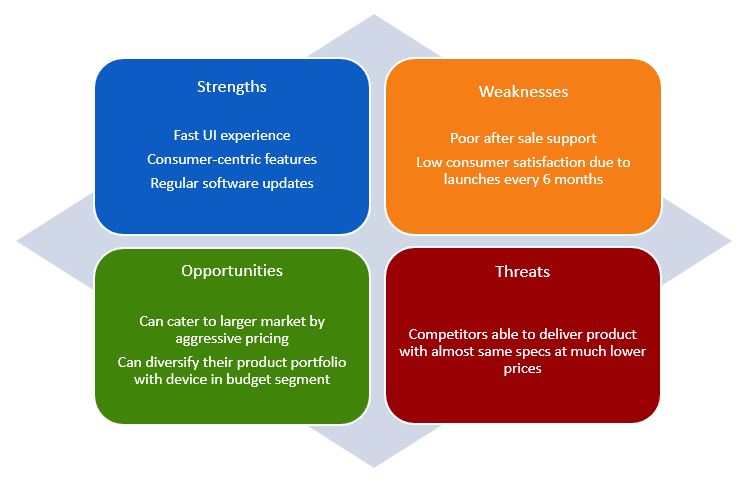
 As expected, Oneplus 6 was launched with even a higher price point than it's predecessor. The problem is that from it's last two-three launches, increase in number of features by Oneplus is not able to fully justify price hike. On top of that, new phone launches every six month keeps viable consumers guessing of next launch. Oneplus is already dealing with small consumer base in markets like India. It is very hard to think that with price hikes and frequent launches, Oneplus would be able to keep adding to list of people they serve, keeping in mind that any existing customer in these markets do not upgrade their  smartphones that often.

SWOT Analysis


Monday, July 3, 2017

ATTENTION!!! MISSING 3.5 mm HEADPHONE JACK. PLEASE REPORT IF FOUND....


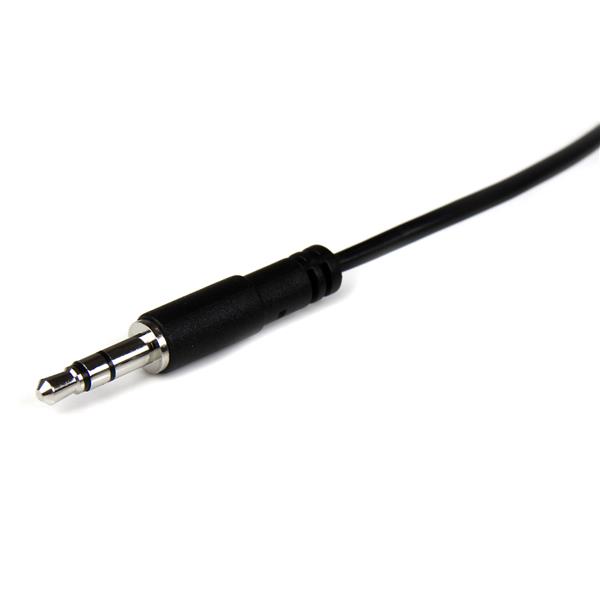
MISSING HEADPHONE JACK...


So, as you would have come to know till now, yeah it’s true, USB type C is going to be the new standard in android phones. 3.5 mm headphone jack was there for nearly 140 long years. Lightening port in iPhones and USB type C are going to replace your old trusty 3.5 mm headphone jack in coming years.

Guess. Who started it all? 


If you guessed it Apple just because it was absent on latest iPhone 7, you will surely be surprised to know that you got it wrong this time. No it wasn't Apple instead a Chinese smartphone making company Oppo.
Yes, Oppo's Finder launched way back in 2012 lacked a headphone jack followed by their another phone R5 in 2014 only to keep Oppo R5 freaking 4.85 mm thin.


After that it was only in 2016 that another Chinese company LeEco had courage to launch LeEco Le2 and Le Max 2. It was after then Apple's iPhone 7 included earpods with lightening connector and no place for headphone jack on iPhone.

Enough of history for now, so what does it all mean for upcoming devices and what is going to be company's approach towards this new trend in smartphone industry?

Well it seems like that whether it is these Chinese companies like Oppo, Xiaomi, Lenovo, Oneplus or tech giants like Apple, no one is really pushing it's customers really hard to completely switch to new technology. This can be understood by the fact that all such companies included an adapter to plug those old trusty headphones. It is due to a simple fact that their premium customers might switch to other high-end smartphone having a headphone jack for best experience of high quality expensive headphones.

FUN FACT:

Samsung, although being leader in android smartphones, decided to keep 3.5 mm headphone jack on all it's flagships phones till now, including the latest s8 and s8+.

The usual reason stated by companies like Leco is that sound output is going to be clearer on digital USB-C connection and users will enjoy better audio experience on their new CDLA technology. Interestingly, LeEco was able to clear their inventory on very first day of sale, gathering 1.22 billion RMB.

Apple also stated their 3 main reasons on dropping headphone jack during iPhone 7 launch event.

 First being the fact that now users can use their new earpods with lightening connector at the end and continue to use their headphones using an adapter, both included in box (Seriously Apple, does this even really qualify for being a reason??).

Second reason, headphone jack takes up lot of precious internal space, so ditching it, not only created space for dual lens camera system on 7 plus model but also for a new hepatic engine.

Third reason is that they believed that wireless is the future and thus they introduced airpods (wireless earpods) for just $160.(Only Apple can do this, just Apple things)


According to industry experts,  the real reason behind this move by Apple is to open a new revenue stream. Yes that's right, there is a lot going on than that you might have expected.
 Just because lightening connector is proprietary to Apple, any manufacturer who come up with 3rd party accessories with lightening connector, has to pay Apple for each item sold. As you might have guessed till now, these manufacturers pass on this royalty fees to customers in form of higher prices. 
In the end it is a customer who suffers and Apple makes money without getting involved in this transaction.


The real problem is not the fact that Apple is charging royalty fee for their patented port, but the fact that it is as high as $4-5 per item when compared to that of HDMI cable ($0.05).

So,what does it all comes down to?

 One simply does not get a real better audio experience from these new connectors. Losing the ability to charge your device while listening to music is frustrating for some users.

We hope that these shortcomings gets sorted out in coming years. Until then, I wish everyone 

A VERY HAPPY DONGLE LIFE !!!